
Africa's education and training systems continue to face persistent challenges in access, equity, quality, relevance, and skills alignment, despite notable progress in recent years. An estimated 20% of children aged 6–11 are out of school, increasing to 33% for those aged 12–14, and about 60% of youth aged 15–17 remain excluded from education, with girls disproportionately affected.
Additionally, a shortage of qualified teachers, uneven teacher distribution, limited opportunities for continuous professional development, and a growing mismatch between education outcomes and labour market needs undermine learning quality and employability.
At the post-basic level, Technical and Vocational Education and Training (TVET) systems across Africa face structural constraints including outdated curricula, weak industry linkages, limited digital integration, insufficient green and climateresponsive skills training, and inadequate incorporation of Artificial Intelligence (AI), robotics and emerging technologies.
Similarly, higher education institutions often operate with limited research capacity, weak innovation ecosystems, and insufficient mechanisms for knowledge transfer and commercialization, gaps that constrain Africa's ability to leverage science, technology and innovation (STI) as drivers of wealth creation and societal problem-solving, as envisioned under the Science, Technology and Innovation Strategy for Africa (STISA-2034).
Addressing these challenges requires innovative, scalable, cost-effective, and system-integrated solutions tailored to Africa's context. Innovations must tackle issues of access, relevance, employability, productivity and resilience, including strengthening teacher training, higher education transformation, TVET modernization, industry partnerships, digitalization, and green skills ecosystems.
Critically, such solutions must also advance the strategic priorities of STISA-2034, including:
(i) strengthening STI infrastructure and research capacity
(ii) promoting a culture of innovation and entrepreneurship
(iii) accelerating research commercialization and technology transfer
(iv) fostering triple-helix partnerships among government, academia, and industry.
Eligibility Criteria
Applications will be accepted from citizens of AU Member States leading an organization that meets the following criteria.
- Successfully implementing an education innovation in one or more AU Member States with verifiable outcomes. An education innovation refers to a product or service being offered by an organization that uses a relatively distinct approach — with respect to the African context— in addressing challenges in the education system.
- Legally registered and licensed to operate in an AU Member State.
- Directly responsible for the implementation and management of the innovation, i.e., not acting as an intermediary.
- Demonstrates potential for integration into public systems and alignment with continental frameworks including CESA 2026–2035, CTVET 2025–2034, and STISA-2034.
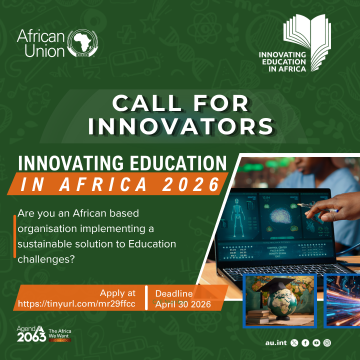
Deadline for submissions: 30 April 2026 by 23:00 EAT (GMT+3).
Inquiries may be sent to: Mr. Chigozie Emmanuel Okonkwo – Education and Skills Advisor | Email: OkonkwoC@africanunion.org
For more information visit the call for submission doc here