
NAIROBI, April 24, 2026 — In a move that could fundamentally rewrite the economic landscape of East Africa, Aliko Dangote, Africa’s richest man, has officially pledged to lead the construction of a massive oil refinery in the Tanzanian port city of Tanga.
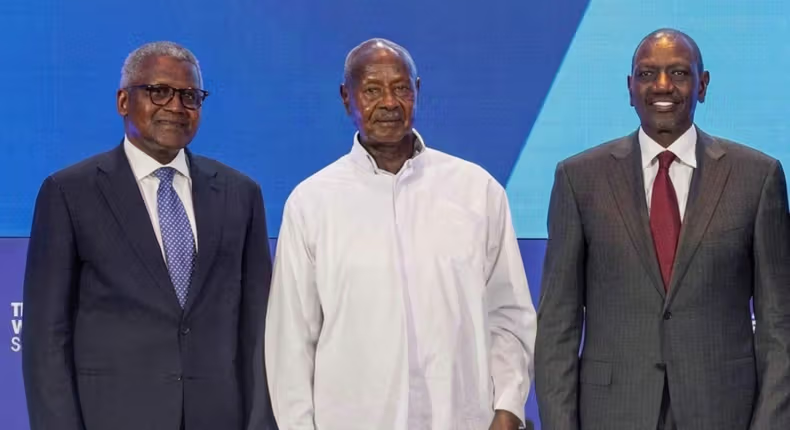
The announcement came during a high-stakes panel at the "Africa We Build" Summit in Nairobi, where Dangote stood alongside Kenyan President William Ruto and Ugandan President Yoweri Museveni. The proposal arrives at a critical juncture, as the ongoing conflict in the Middle East has severely disrupted fuel supply chains, exposing the vulnerability of East African nations that rely on the Persian Gulf for nearly 75% of their refined petroleum.
Replicating the "Nigerian Miracle"
Dangote’s vision for the Tanga facility is nothing short of ambitious. He has committed to building an "identical" version of his flagship 650,000 barrel-per-day (bpd) refinery in Lagos, Nigeria, currently the world’s largest single-train facility.
"If the political backing is there, we will build it," Dangote told the applauding summit participants. "I can give commitment today that we will lead this. We’ll make sure that refinery is built within the next four to five years."
A Shared Regional Powerhouse
The Tanga refinery is being framed not just as a Tanzanian project but as a collective East African asset. Key features of the proposed plan include:
Regional Feedstock: The facility will process crude oil from across the region, including the fields of Uganda, South Sudan, Kenya, and the Democratic Republic of Congo (DRC).
Strategic Infrastructure: A new pipeline is planned to link the refinery in Tanga to the Kenyan port of Mombasa, ensuring a seamless flow of refined products across borders.
Synergy with EACOP: The project will leverage the existing 1,443-km East African Crude Oil Pipeline (EACOP) currently connecting Uganda’s oil fields to the Tanzanian coast.
The "Near Criminal" Export of Raw Materials
The summit was marked by sharp rhetoric from regional leaders regarding Africa's historical role as a raw material exporter. President Museveni described the export of unprocessed resources while importing expensive finished goods as "near criminal", noting that African economies lose billions in value and millions of jobs to foreign refiners.
President Ruto echoed this sentiment, stating that the region can no longer afford to "acquiesce to the status quo. " The Africa Finance Corporation (AFC) recently projected that the continent’s fuel import shortfall will reach 86 million tonnes by 2040, a gap that would require at least three refineries of Dangote’s scale to bridge.
Timeline and Next Steps
While the project is in its early stages, Dangote indicated that preliminary works are already part of his broader $40 billion industrial expansion strategy. If the regional governments—Tanzania, Kenya, and Uganda—formalise their policy support, construction could begin within the year, aiming for a 2030 operational date.
The refinery is expected to do for East Africa what the Lagos plant did for West Africa: stabilize fuel prices, guarantee energy security, and position the region as a net exporter of petroleum products to the global market.