
Africa's Most Consequential Resource Partnership Is Being Built From the Ground Up
When external powers compete for access to frontier resource territories, the decisive advantage rarely belongs to whoever arrives first with capital. It belongs to whoever arrives with the most complete understanding of what lies beneath the surface. Geological intelligence — the granular subsurface data that maps what exists, at what depth, in what concentration, and at what extraction cost — is the foundational asset in any resource competition. Before a single tonne is mined or a cubic metre of gas is piped, the party that controls the survey data controls the negotiating table.
This principle sits at the core of the recently announced China Mozambique gas and minerals deal, a sweeping bilateral agreement signed following direct presidential-level talks in Beijing between Chinese President Xi Jinping and Mozambican President Daniel Chapo. The arrangement is structurally unlike any previous Sino-African resource pact and represents something considerably more ambitious than a commodity access agreement. It is, in analytical terms, a long-cycle sovereign integration strategy.
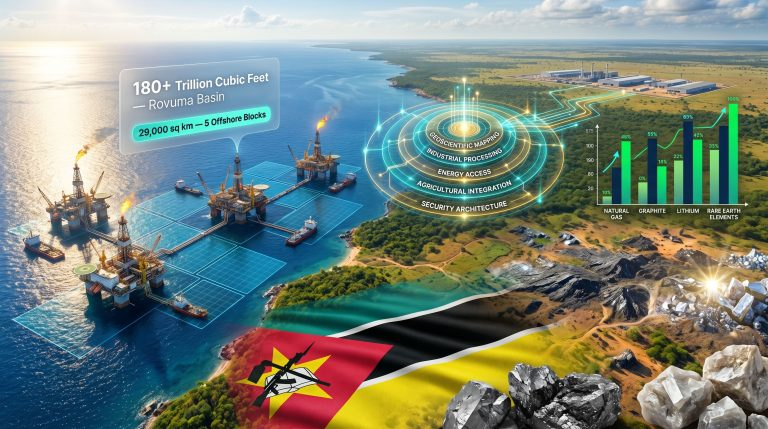
What Separates This Deal From Every Previous Sino-African Resource Agreement?
Most historical resource agreements between China and African nations followed a recognisable template: Chinese state-backed capital finances infrastructure, typically roads, ports, or railways, in exchange for preferential access to extractive assets. The infrastructure-for-resources model delivered tangible outcomes in both directions but left the host nation structurally positioned as a raw material exporter rather than an industrial participant.
The China-Mozambique framework, however, departs from this template across four interlocking dimensions that together constitute a qualitatively different form of engagement:
- Geoscientific intelligence gathering through comprehensive geological surveys of Mozambique's largely unmapped northern mineral deposits
- Industrial infrastructure investment, with Chinese financing directed toward domestic processing plants designed to shift Mozambique from raw commodity export toward value-added manufacturing
- Energy system development encompassing LNG infrastructure, power generation capacity, and renewable energy frameworks
- Security architecture, including counterterrorism training, military equipment transfers, and joint exercises targeting insurgency-affected zones in Cabo Delgado province
The simultaneous deployment of all four dimensions within a single bilateral framework is what gives this deal its strategic weight. Each pillar reinforces the others: security stabilisation unlocks geological access, geological data enables informed industrial investment, and industrial investment creates the export infrastructure that monetises the energy assets.
Mozambique's Resource Endowment: Scale, Composition, and Strategic Value
Understanding why this deal matters requires a clear picture of what Mozambique actually holds in the ground, and why those resources carry outsized significance in the current global energy and manufacturing transition.
| Resource Category | Estimated Scale | Primary Location | Global Significance |
|---|---|---|---|
| Natural Gas | 180+ trillion cubic feet (5 trillion cubic metres) | Rovuma Basin | Top-tier LNG export potential |
| Graphite | Significant untapped reserves | Cabo Delgado (north) | Battery anode supply chain |
| Lithium | Underexplored deposits | Northern provinces | EV battery manufacturing |
| Rare Earth Elements | Largely unmapped | Northern provinces | Advanced technology inputs |
| Offshore Oil and Gas | 29,000 sq km across five blocks | Offshore (500-2,500m depth) | New hydrocarbon frontier |
The Rovuma Basin's more than 180 trillion cubic feet of proven natural gas places Mozambique among the top tier of gas-endowed nations globally, comparable in reserve scale to major LNG exporters. The basin's deepwater pre-salt architecture, with hydrocarbon-bearing formations at significant depth, is technically analogous to Brazilian pre-sal fields that transformed that country's energy export profile over two decades. Furthermore, the broader implications for global LNG supply dynamics are considerable, given Mozambique's proximity to high-demand Asian markets.
But it is the critical minerals dimension that generates the most strategic interest in the current global environment. Graphite, lithium, and rare earth elements in Mozambique's northern provinces are simultaneously in high demand globally and largely unquantified due to the convergence of security disruption and infrastructure deficits that have prevented systematic geological surveying.
According to the International Energy Agency's projections on critical minerals demand and the clean energy transition, graphite demand alone is expected to increase several times over by the mid-2030s as electric vehicle production scales globally, with the mineral serving as the primary anode material in lithium-ion battery cells.
"The combination of a world-class natural gas basin and an unmapped critical minerals frontier in the same country is genuinely rare. Mozambique holds the dual role of energy supplier and materials supplier for the global green energy transition, and the China Mozambique gas and minerals deal positions Beijing to shape both dimensions simultaneously."
For offshore hydrocarbons, CNOOC subsidiaries have signed exploration and production contracts covering five blocks totalling approximately 29,000 square kilometres at operational depths ranging from 500 to 2,500 metres.
The initial exploration mandate spans four years. This commitment extends a relationship that predates the current agreement; CNOOC signed a gas purchase agreement with Mozambique's state energy company ENH as early as 2019, demonstrating a sustained strategic orientation toward the Rovuma Basin rather than an opportunistic entry.
The Geoscience Advantage: Why Data Is the Real Prize
The geological survey component of the agreement is delivered through two institutional vehicles: the China-Africa Geoscience Cooperation Centre and the Belt and Road International Geoscience Education and Training Centre. These platforms provide the organisational framework for conducting systematic mineral mapping across Mozambique's northern provinces.
What makes this dimension strategically significant is a dynamic that is rarely discussed in mainstream coverage of resource agreements. Subsurface geological data — the detailed survey intelligence that quantifies what minerals exist, at what ore grades, in what deposit geometries, and at what extraction economics — is not simply technical information. It functions as a strategic asset that creates durable informational asymmetry.
Whoever holds the survey data understands:
- Which deposits warrant development investment and which do not
- What ore grades and tonnages are commercially viable at current commodity prices
- Which areas should be prioritised in future licensing rounds
- What processing infrastructure will be required and at what capital cost
- How competing mineral projects in adjacent regions compare on economic merit
"China's geological survey investment operates as a data-acquisition strategy. Early-mover access to subsurface intelligence creates an informational advantage over future licensing rounds that no amount of capital commitment can easily replicate once that asymmetry is established."
Mozambique's northern mineral deposits remain largely unsurveyed because the Cabo Delgado insurgency, active since 2017, has made systematic field survey work logistically and physically dangerous. Infrastructure deficits compound the problem: limited analytical laboratory capacity, inadequate road access to survey sites, and restricted equipment mobility have collectively frozen the geological knowledge base for an entire mineral-rich corridor.
This is precisely why the geological survey component of the deal is sequenced first. Without a quantified subsurface picture, no rational investment decision can be made about processing infrastructure. China is effectively offering to bear the cost and risk of mapping a resource frontier that will subsequently anchor all downstream industrial decisions.
You can refer to the original story here