
African startups raised US$2.10 billion across 275 deals between January and August 2026, a modest 1.4% rise on the US$2.07 billion raised over the same period last year, according to TechCabal's tracking of the continent's disclosed and undisclosed funding rounds. But the headline number hides a sharper story underneath it: money is concentrating into fewer, larger deals, and the founders who used to fill the gap beneath them are increasingly funding themselves.
August alone brought in US$438 million, a 368% jump on August 2025. According to tracking by Africa: The Big Deal and TechCabal Insights, more than 90% of that month's deployed equity capital sat in just two transactions: Moove's US$250 million Series C, backed by Abu Dhabi's Mubadala, Woven Capital and Ion Pacific, and Jumia's US$50 million equity raise from the IFC and Axian.
Nigeria holds the lead, but the map is shifting
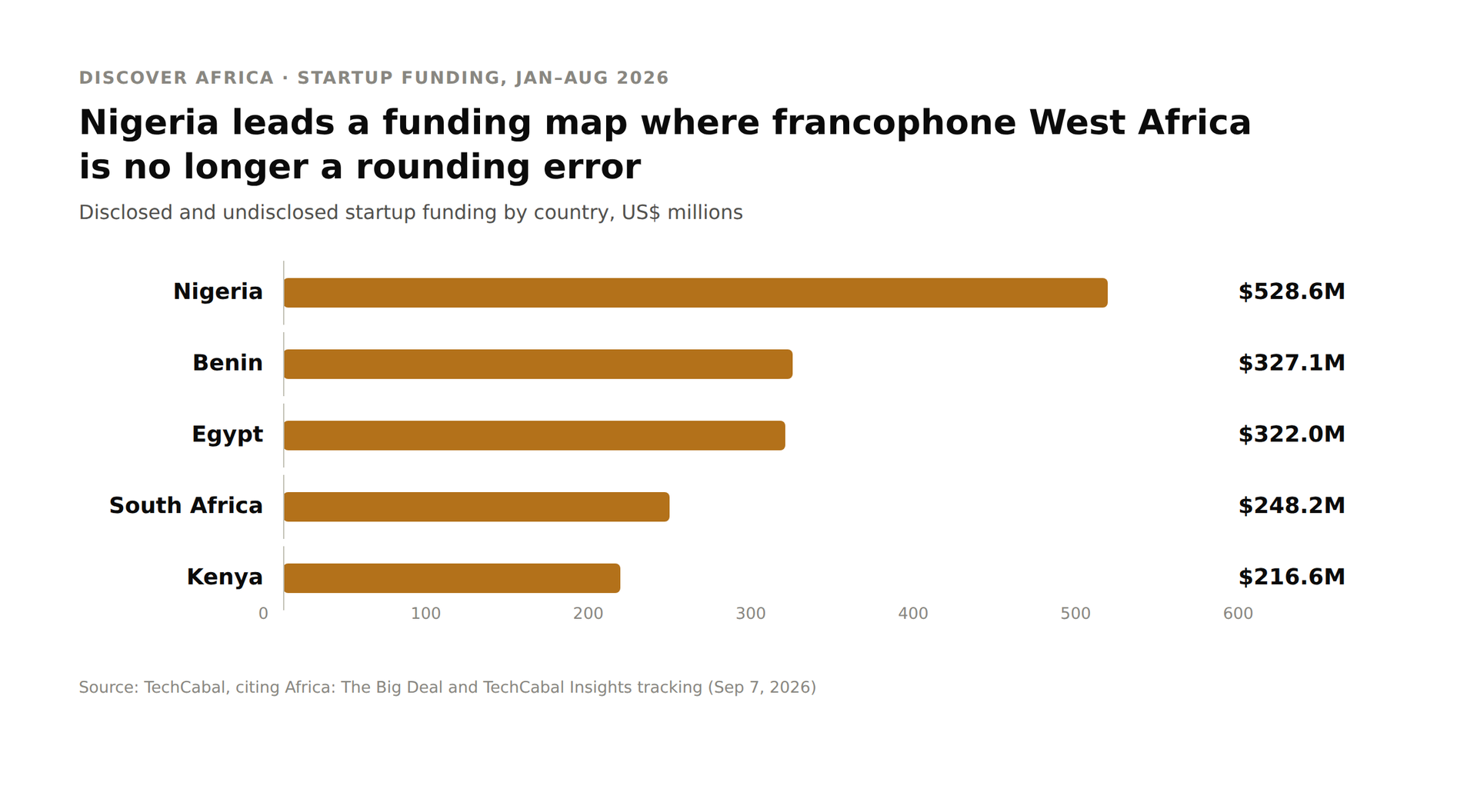
Nigeria remained the continent's top destination for capital at US$528.6 million for the eight-month period, but the countries behind it tell a more interesting story. Benin placed second at US$327.1 million, ahead of Egypt (US$322.0 million), South Africa (US$248.2 million) and Kenya (US$216.6 million), a reminder that francophone West Africa is no longer a rounding error in a conversation that used to run almost entirely through Lagos, Nairobi and Cairo. Mobility, e-commerce and clean energy drew the bulk of the capital, with fintech firm Yellow Card (US$40 million, backed by SC Ventures, Sony Innovation Fund, Polychain Capital and Blockchain Capital) and agritech lender ThriveAgric (a US$3.93 million debt facility) among the smaller deals rounding out August's list.
Early-stage founders bet on non-dilutive capital
The concentration at the top is squeezing the middle. With mega-deals absorbing most of August's disclosed equity, founders earlier in their journey are increasingly turning to government grants and Web3-ecosystem cheques under US$150,000 rather than competing for institutional venture capital, a shift toward non-dilutive capital and revenue-first economics over the growth-at-all-costs playbook that defined the previous funding cycle.
"If nobody writes that cheque in 2026, there's no Series A class in 2029. We'd rather own that pipeline than inherit someone else's gap in three years." — Uwem Uwemakpan, Head of Investments, Launch Africa Ventures
Uwemakpan's warning, made in a separate July interview about the same trend, is the stake underneath this month's numbers: a funding map that looks healthy in aggregate can still be hollowing out from the middle, one skipped seed round at a time.
What the concentration means for 2029
If 2026's mega-deals keep crowding out the smaller checks that produce tomorrow's Series A class, the continent's funding pipeline three years out looks thinner than this month's US$2.10 billion headline suggests. The eight-month total is a record of what got funded, not yet a verdict on who gets funded next.